You might have had such an experience in your career as an accountant when the last week of the month came suddenly and you realized that all your planned tasks doubled in volume overnight. Invoices need to be matched, bank accounts reconciled, and most importantly, all those long-awaited reports by the leadership need to be designed and presented. You may have seen the worried faces of your superiors before you even started on the close.Working with finance teams, I have come to notice that those who tend to dread the end of the month the most are usually those whose close process is largely run on intuition and guesswork. Having the proper checklist is what will allow a finance team to keep their close orderly and on time. It is, however, not a simple task to think of and design such a document, and most teams that try to do it on the fly waste a lot of time and energy on unproductive activities while missing out on truly important steps.This is why in this guide, I will talk you through creating an adequate month-end close checklist suitable for your finance team. We will discuss what a month-end close checklist really is and what it should include, go over the rationale and benefits of having such a document, and finally create a sample one you can use as a starting point.
Month-End Close Checklist: Definition and Contents
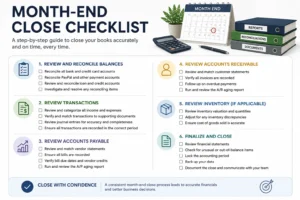
A month-end close checklist is a document, usually a spreadsheet, that includes all the operations and controls performed by a finance team at the end of the month to close their books.Most often, such a document will include a list of reconciliations, journal entries, and reports that need to be prepared and reviewed. The order of operations may also be defined, especially if the checklist is used as a guidance for others. In any case, a properly designed month-end close checklist will serve as a reference point for a finance team’s monthly close process.Most organizations close their books anywhere between three to ten days after the end of a month, with the duration of the close period depending on the complexity of each particular organization’s accounting. From my experience, those teams that manage to keep their close around the lower end of the spectrum, i.e., between three and five days, tend to have a checklist that they update religiously rather than trying to rely on guesswork every month.
Why Have a Checklist? Benefits and Rationale
A checklist may seem like a trivial exercise, something that serves only to fulfill the requirements of an overly organized compliance department. However, anyone that has experienced the consequences of a poorly designed close process will quickly realize the many benefits that such a document as a month-end close checklist can bring to a finance team. Here are just some of the benefits:
Fewer errors made
Less time spent on the close
Easier audits and regulatory reviews
Faster onboarding of new team members
Greater sense of responsibility and accountability
Fewer errors are made when a finance team follows a checklist simply because there are fewer opportunities for mistakes to occur.When the steps to perform are specifically defined and laid out in front of you, it is far easier to design a reliable process that will minimize the possibility of human error. Moreover, since all of the necessary steps are written and followed in a specific order, it is far easier to spot those that were skipped, usually due to human error.The time spent on the close is reduced not only because of the decreased number of errors but also because of increased productivity. The time finance teams waste on the close every month is outrageous, with most of it being lost on unproductive tasks such as asking each other what needs to be done next or referring to old emails to see what steps have been taken already. By simply following a clearly written checklist, a team can significantly accelerate the close process as everyone will know what to do and when to do it.Finally, having a month-end close checklist makes a finance team infinitely easier to audit, review, and monitor. Auditors will always look favorably upon a finance team that presents them with extensive documentation, which a month-end checklist would provide. By reviewing such a document, an auditor would have a better understanding of the close process for a particular team and its reliability.Moreover, a month-end close checklist will greatly accelerate the onboarding process of new members in a finance team, allowing them to become productive sooner and to learn the ropes of the position faster. Additionally, a well-designed document will increase your team’s overall sense of responsibility, as most of the close steps will likely have an assigned owner who would be responsible for its execution.
Month-End Close Checklist: Sample Template
This is what a generic month-end close checklist may look like for most organizations. Obviously, each finance team will have to tailor those steps to their particular needs, but most organizations will find similarities with their own close processes.
10 Steps to Month-End Close
1. Record and Review Transactions
Confirm that all sales invoices for the month have been issued and recorded
Review that all vendor bills and expenses are captured accordingly
Check that there are no items left in suspense or other accounts they should not be in
2. Reconcile Bank and Credit Card Accounts
Reconcile all bank accounts and credit card accounts with the accounting software
Investigate and resolve all discrepancies found
Confirm that outstanding checks and deposits are accounted for accordingly
3. Review Accounts Receivable
Follow up on all overdue invoices, where applicable
Review if any bad debt, doubtful account, or similar provision needs to be recorded
Reconcile the A/R subledger with the general ledger
4. Review Accounts Payable
Review that all invoices received have been recorded and correctly classified
Reconcile the A/P subledger with the general ledger
Review that there are no outstanding payments to vendors
5. Record Accruals and Prepaids
Record all accruals of expenses incurred but not yet paid
Adjust all prepaids accordingly
Accrue revenues, if applicable to the organization’s operations
6. Reconcile Payroll
Reconcile payroll liabilities with processed payroll
Confirm that payroll tax liabilities have been recorded correctly
Review employee reimbursements, benefits, and related accruals
7. Review Fixed Assets and Depreciation
Record depreciation expenses for the month
Add any assets purchased or remove those disposed of during the month
Reconcile the fixed asset register with the general ledger
8. Review Inventory, if applicable
Confirm that all inventory items on hand match the recorded counts
Record all write-offs discovered during the inventory count
Reconcile cost of goods sold with inventory purchases for the month
9. Review the General Ledger
Look over the general ledger for any unusual figures or variances
Confirm that all journal entries have been properly reviewed and authorized
Review that all intercompany journals have been eliminated
10. Final Review and Closing
Prepare a trial balance and review it for any variances
Prepare the income statement, balance sheet, and cash flow statement
Double-check all numbers and review by another team member
Final close of the month to prevent further changes
How to Accelerate Your Own Month-End Close
Having a month-end close checklist is a great first step toward a reliable and quick end-of-month close for your finance team. However, not all finance teams that have a checklist are equally successful at closing their books quickly. Here are several additional steps that will allow your finance team to accelerate the month-end close process.Do daily or weekly close activities instead of leaving everything until the last days or weeks. It is much easier to process the month-end close gradually throughout the month than to save all of the reconciliations, adjustments, and reviews for the very end. Leaving everything until the last-minute creates unnecessary extra pressure on a finance team that is bound to slow them down.Standardize your processes as much as possible and create uniform templates for all recurring journal entries, reports, and other transactions. Although it may seem like extra work, such standardization will make your close process much more reliable and faster. Most importantly, standardization will minimize the number of questions or concerns from other team members and stakeholders, as there will be nothing to compare to – everything will be uniform.Automate your accounting processes as much as possible using accounting or finance software. Such tools will allow you to automate most of the repetitive tasks involved in the end-of-month book closing, including, but not limited to, bank reconciliation, journal entries, and report generation.Assign specific owner to each item on your month-end close checklist rather than leaving them open for all team members. This way, every task will have someone that will be directly responsible for it, which will, in turn, increase your team’s sense of responsibility and accountability.Always keep track of how long your close process takes. If you have been noticing a tendency for the time spent on the close to increase every quarter or year, it is a sign that your processes need optimizing before even more time is wasted.Finally, remember to update your documents, particularly your month-end close checklist, on a regular basis, not to forget about small but crucial updates. Updating your documents is essential for keeping your finance team productive and effective.
Common Errors in Month-End Close
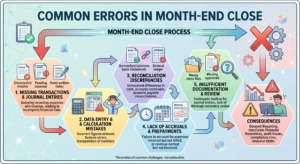
Here are some of the most common errors finance teams tend to make throughout the end-of-month close process.Missing reconciliations is one of the most common errors finance teams make on a monthly basis, mostly due to their understimating the importance of consistent and reliable month-end closing procedures. Teams will usually skip certain reconciliations, believing that they are unnecessary or insignificant. In reality, however, every reconciliation that has been scheduled ought to be completed, regardless of its apparent usefulness and complexity.Variation in accrual methods is another common mistake that most often occurs at the very start of the month. It is normal for accounting teams to change accrual methods on a yearly basis, but such modifications ought to be avoided when it comes to month-end close since they can introduce unnecessary complications.Not documenting manual journal entries is another frequent error that can cause serious issues for a finance team in the future. When a journal entry is created manually, the team that creates it ought to document the reasoning behind it in detail. Otherwise, such information may be lost, making it difficult to understand the journal entry’s purpose.Forgetting to get ahead of the close is yet another common error that is often due to planning and time management issues. Even the most competent finance teams can make this mistake when they do not leave enough time for the closing of the month to finish. To avoid this error, teams ought to plan ahead in advance and try to minimize the workload they have to process at the end of the month.Finally, neglecting to update the month-end close checklist is another error that is all too common among finance teams. The document often accumulates numerous updates that ought to be integrated before the next month-end close. Some updates may seem too minuscule to matter, but they can seriously impact the efficiency and effectiveness of the close process.
Conclusion
To summarize, I would like to note that a proper month-end close checklist may not solve every issue your finance team faces with the month-end close process, but it will certainly help you deal with the majority of them. It will streamline your current operations, provide your team with a reliable reference point, and eliminate numerous costly mistakes that can occur during the closing of the books.Should your finance team still find itself overwhelmed with the month-end close process, you may want to consider designing or updating your own month-end close checklist. To begin with, you can use the sample document provided in this article to build your own version of it and assign specific responsibilities to your team members. After a few months of using it, you ought to review the document to see what changes, if any, need to be made.
Frequently Asked Questions
How long should my month-end close last?Depending on your business’s size and complexity, your month-end close should ideally last between five and ten business days. Small businesses with simple accounting operations may be able to finish the close even faster, within two to five business days.Who should be responsible for the checklist?A month-end close checklist is usually designed and maintained by either the finance or accounting team. Most tasks on the document are usually assigned to specific team members to ensure greater productivity and accountability.Can a small business use a simplified version of the checklist?Yes, small businesses can and often do use a simplified version of the document since most of it is geared toward larger organizations and more complex accounting operations.What software can accelerate the end-of-month book closing?Most accounting software these days offer automation features that are capable of accelerating the month-end close process. Ideally, a finance team should utilize as many automation functions as possible to reduce the amount of work needed to close the books each month.How often should I update the month-end close checklist?Ideally, you should update the document at least once a year or every time your business undergoes a significant organizational change.

 A month-end close checklist is a document, usually a spreadsheet, that includes all the operations and controls performed by a finance team at the end of the month to close their books.
Most often, such a document will include a list of reconciliations, journal entries, and reports that need to be prepared and reviewed. The order of operations may also be defined, especially if the checklist is used as a guidance for others. In any case, a properly designed month-end close checklist will serve as a reference point for a finance team’s monthly close process.
Most organizations close their books anywhere between three to ten days after the end of a month, with the duration of the close period depending on the complexity of each particular organization’s accounting. From my experience, those teams that manage to keep their close around the lower end of the spectrum, i.e., between three and five days, tend to have a checklist that they update religiously rather than trying to rely on guesswork every month.
A month-end close checklist is a document, usually a spreadsheet, that includes all the operations and controls performed by a finance team at the end of the month to close their books.
Most often, such a document will include a list of reconciliations, journal entries, and reports that need to be prepared and reviewed. The order of operations may also be defined, especially if the checklist is used as a guidance for others. In any case, a properly designed month-end close checklist will serve as a reference point for a finance team’s monthly close process.
Most organizations close their books anywhere between three to ten days after the end of a month, with the duration of the close period depending on the complexity of each particular organization’s accounting. From my experience, those teams that manage to keep their close around the lower end of the spectrum, i.e., between three and five days, tend to have a checklist that they update religiously rather than trying to rely on guesswork every month.
 Here are some of the most common errors finance teams tend to make throughout the end-of-month close process.
Missing reconciliations is one of the most common errors finance teams make on a monthly basis, mostly due to their understimating the importance of consistent and reliable month-end closing procedures. Teams will usually skip certain reconciliations, believing that they are unnecessary or insignificant. In reality, however, every reconciliation that has been scheduled ought to be completed, regardless of its apparent usefulness and complexity.
Variation in accrual methods is another common mistake that most often occurs at the very start of the month. It is normal for accounting teams to change accrual methods on a yearly basis, but such modifications ought to be avoided when it comes to month-end close since they can introduce unnecessary complications.
Not documenting manual journal entries is another frequent error that can cause serious issues for a finance team in the future. When a journal entry is created manually, the team that creates it ought to document the reasoning behind it in detail. Otherwise, such information may be lost, making it difficult to understand the journal entry’s purpose.
Forgetting to get ahead of the close is yet another common error that is often due to planning and time management issues. Even the most competent finance teams can make this mistake when they do not leave enough time for the closing of the month to finish. To avoid this error, teams ought to plan ahead in advance and try to minimize the workload they have to process at the end of the month.
Finally, neglecting to update the month-end close checklist is another error that is all too common among finance teams. The document often accumulates numerous updates that ought to be integrated before the next month-end close. Some updates may seem too minuscule to matter, but they can seriously impact the efficiency and effectiveness of the close process.
Here are some of the most common errors finance teams tend to make throughout the end-of-month close process.
Missing reconciliations is one of the most common errors finance teams make on a monthly basis, mostly due to their understimating the importance of consistent and reliable month-end closing procedures. Teams will usually skip certain reconciliations, believing that they are unnecessary or insignificant. In reality, however, every reconciliation that has been scheduled ought to be completed, regardless of its apparent usefulness and complexity.
Variation in accrual methods is another common mistake that most often occurs at the very start of the month. It is normal for accounting teams to change accrual methods on a yearly basis, but such modifications ought to be avoided when it comes to month-end close since they can introduce unnecessary complications.
Not documenting manual journal entries is another frequent error that can cause serious issues for a finance team in the future. When a journal entry is created manually, the team that creates it ought to document the reasoning behind it in detail. Otherwise, such information may be lost, making it difficult to understand the journal entry’s purpose.
Forgetting to get ahead of the close is yet another common error that is often due to planning and time management issues. Even the most competent finance teams can make this mistake when they do not leave enough time for the closing of the month to finish. To avoid this error, teams ought to plan ahead in advance and try to minimize the workload they have to process at the end of the month.
Finally, neglecting to update the month-end close checklist is another error that is all too common among finance teams. The document often accumulates numerous updates that ought to be integrated before the next month-end close. Some updates may seem too minuscule to matter, but they can seriously impact the efficiency and effectiveness of the close process.
