You just did the work. You just sent the invoice. Now you just have to wait.
That waiting period between completing a job and getting paid for it is known as accounts receivable. As a small business owner, it might be consuming more of your headspace than it should. Every invoice you send out on credit terms contributes to that ever-growing pile of receivables, and the better you understand them the more control you have over your cash flow situation. These receivables could dictate whether you’re able to pay your assistant, or keep your doors open until next week.
What Accounts Receivable Actually Means
Accounts receivable (AR) is the money owed to your business by customers for goods and services you’ve already provided but not yet been paid for. Anytime you send out an invoice with payment terms instead of cash on delivery, that amount becomes accounts receivable. It’s money you’re owed but haven’t collected yet, and it appears on your balance sheet as a current asset.
AR is also sometimes called trade receivables or bills receivable – different terms, same meaning.
Let’s say you’re a marketing consultant and you send an invoice to a client for $4,000 for a project wrapped up in August, net-30 terms. That $4,000. Once you’ve sent that invoice out, that amount immediately becomes accounts receivable. It remains in that category until the customer pays you in full, or you determine the debt is uncollectible.
Accounts receivable can also refer to the department or person who handles the receivables, especially at larger companies. While in a five person company, this responsibility might fall to you and a check of the QuickBooks account once a week, at larger companies there’s likely a whole team and program dedicated to invoicing and collections.
Accounts Receivable vs Payable – There’s a Difference
It’s easy to confuse the two, especially since they sound similar, but accounts payable and accounts receivable are completely different.
While accounts receivable is money customers owe you, accounts payable is money that you owe to others. If you sold $8,000 worth of equipment to a client on credit, you record $8,000 in AR, the customer would record that same amount in accounts payable. Both sides of the transaction are visible to anyone looking at your finances.
Because they affect cash flow from either direction, it’s important to keep both in mind. If your customers aren’t paying you as quickly as you need, it could have a direct impact on your ability to pay your own invoices on time.
How the Process Actually Works
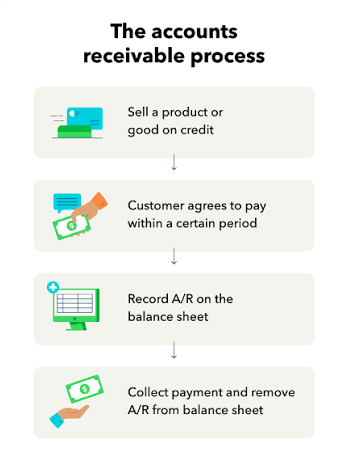
The accounts receivable process, also known as the order-to-cash process, consists of several steps.
- Credit approval. Before sending out any invoice, you have to decide what terms to extend to the customer. This means determining the risk of non-payment and deciding whether to accept deposits for larger jobs, or require references for new clients.
- Invoice creation. Creating the invoice with terms and conditions. This should include payment terms, amounts due, and instructions for payment.
- Invoice delivery. Invoicing is useless if the customer doesn’t get it, so make sure to send the invoice out promptly.
- Payment tracking. Tracking which invoices are outstanding, and by how much.
- Collections and follow-up. Following up with customers about overdue invoices.
- Payment application. Applying payments to invoices, or marking them as paid if received in full.
- Reconciliation. Matching the receivables with the cash actually received to close the ledger.
Where Most Small Businesses Go Wrong
On average, most single person businesses or small teams don’t fail at step one. They fail at step five when it comes to collections. Invoices are issued, but because nobody is responsible for collections, or it’s the assistant’s job and they always seem to forget, those invoices sit on the shelf until they become delinquent. Then, if payments come in but aren’t applied properly, an otherwise solvent customer is marked as owing more than they do.
If any of this sounds familiar, it doesn’t mean you’re a bad business person. It means that the process likely doesn’t have the automation it needs, or there isn’t somebody specifically responsible for following up on invoices.
The Two Metrics That Determine If You’re Doing It Right
There are two main methods of evaluating how well you’re managing your accounts receivable.
Accounts Receivable Turnover Ratio
Also known as the turnover, this ratio shows how many times a year a company collects its average accounts receivable. The higher the ratio, the more frequently a company collects its receivables.
To calculate it, divide your net credit sales by your average accounts receivable.
Let’s say your business has $360,000 in net credit sales over the year, with an average AR balance of $36,000 which is $360,000 ÷ $36,000 = 10. Your turnover would be 10, meaning you collected the receivables 10 times per year, or roughly every 36 days. A higher ratio is usually preferable, though it can vary between industries. Most small businesses aim for a ratio between 7 and 10, with larger numbers being better. However, there’s a point where a higher ratio indicates riskier credit terms. A construction company billing on a per project basis, for example, will necessarily have a lower turnover than a nearby restaurant.
Days Sales Outstanding
Days sales outstanding (DSO) is similar to the turnover ratio, but inverted to show how many days on average it takes to collect payment after a sale.
The formula is (Average accounts receivable / net credit sales) x 365.
Using the same figures as the example above, the DSO would equal ($36,000 ÷ $360,000) × 365 = 36.5 days.
In general, a lower DSO is preferable, though a number below 45 is usually a good benchmark. DSO can be a good predictor of future cash flow issues as it shows, on average, how quickly receivables are being collected. A rising DSO is usually an early warning sign of delinquencies, and issues with collections and receivables management.
The One Report That Tells You What’s Going On
An aging report categorizes receivables by how long they’ve been outstanding, and is critical for identifying delinquencies as they occur.
Aging reports make it easy to see which invoices are at risk of becoming delinquent, and to bring collections in on a slow-paying customer.
A possible collections follow up plan based on an aging report might look like this:
- Invoice due date: Send a polite, but firm, reminder email that the invoice is due.
- 7 days past due: Place a phone call or send a more urgent email.
- 14 days past due: Send a formal letter explaining the overdue amount.
- 30+ days past due: Escalate the issue to appropriate collections and/or withhold further work on the account.
Businesses that stay on top of their accounts receivable usually do so because they’re not afraid to follow up with customers about slow payments. Rather than waiting on a customer to call and ask about an invoice, proactive small businesses review their aging reports to spot delinquencies as they occur.
Late Paying Customers Are More Costly Than They Seem
While it might seem like a minor inconvenience, slow-paying customers can actually cripple a small business.
According to a study conducted by US Bank, approximately 82% of small business bankruptcies are the result of cash flow problems. Despite being profitable on paper, businesses can find themselves unable to meet their obligations when they actually need the money, usually because they’re waiting on slow paying customers.
In addition to causing cash flow issues, slow receivables can turn into delinquencies that require more serious collections efforts, which are both time consuming and expensive. Finally, late and unpaid invoices can hurt your ability to access financing, since lenders and investors will view slow-paying customers as a higher risk.
Best Practices For Managing Your Own Accounts Receivable
There’s no need for expensive software or an in-house AR department, but there are a few best practices that can help.
- Set credit terms in advance, rather than negotiating during the sale. Decide which customers will pay cash on delivery, which will receive net-30 terms, and which will be invoiced on a per-project or per-month basis. Set these rules before making a sale, rather than leaving it up to the customer to decide.
- Invoice the day of the sale, rather than the week or month following.
- Provide multiple forms of payment, and include a link on the invoice itself.
- Let the software do the work by setting up automated reminders for each invoice.
- Review the aging report on a weekly basis, rather than once per month.
- Offer an early payment discount, as even 2% off for prompt payment can encourage customers to send the money faster.
When (and How) To Write Off Bad Debt
Unfortunately, sometimes an invoice just will not get paid. That could be because the customer went out of business, or the dispute over the invoice is proving impossible to resolve, or the customer simply refuses to pay.
When it becomes clear that a receivable amount will never be collected, it should be written off as a bad debt. Writing it off moves the amount from your accounts receivable and marks it as a loss, rather than trying to collect on it.
Before writing it off, make sure there isn’t a way to resolve the situation, and that enough time has passed that continued collection attempts won’t do any good. In most cases, a write off is the best option, though it might be appropriate to continue collection attempts if the customer has the means to pay but won’t.
Keep the original invoice on file in case the customer decides to pay, even after writing it off. Even disputed invoices should be resolved before the end of the year, though [A link to Accounting Assist Pro’s year end bookkeeping checklist would be helpful here]
Where It’s Easier Said Than Done
Most problems with accounts receivable facing small businesses occur because the process is poorly documented, rather than inherently confusing. Collections efforts begin inconsistently, with whoever is free doing whatever they feel is necessary, and invoices can get lost due to being sent the same week of invoicing rather than the same day.
Reviewing the aging report to collect on delinquent invoices tends to get pushed back as well, happening once a month rather than once a week. If your AR process is particularly troubled, a clean-up of your books and a review of your invoicing procedure, in conjunction with your CPA, is often the best option. At Accounting Assist Pro, we help small businesses organize their books so that invoices are issued the day of the sale and followed up on until they’re paid, aging reports are reviewed weekly rather than monthly, and collections follow up is consistent across invoices. If your accounts receivable are holding you back, let’s talk about it.
Getting Paid On Time Doesn’t Have To Be Difficult
Accounts receivable isn’t a complicated process, just one that requires consistency and planning. Invoices are issued the day of the sale, rather than the week following, and are sent out immediately rather than being left to gather dust. Invoices get reminders, and collections follow up, until they’re either received or written off. Aging reports are reviewed before slow-paying customers get too far behind, and appropriate follow up occurs.
The fundamentals of accounts receivable don’t change, but small practices like these can have a major impact on cash flow. Understanding how your accounts receivable work is the first step toward improving them. Using the tools already available, like the turnover ratio and aging report, gives you valuable insight into what your AR situation looks like. From there, write-offs and collections follow-ups become easier decisions to make.
Frequently Asked Questions
Is accounts receivable an asset or a liability?
Accounts receivable is an asset, and is recorded as such on the balance sheet. The money owed to you by customers should be considered a current asset – that is, cash you expect to receive within 12 months. The opposite of accounts receivable is accounts payable, which is a liability.
What’s the difference between accounts receivable and accounts payable?
The two concepts are similar but opposite – accounts receivable is what others owe you, while accounts payable is what you owe to others.
What’s a good accounts receivable turnover ratio for a small business?
There isn’t a specific ratio, but most small businesses have a turnover between 7 and 10. This number indicates how many times per year you collect your receivables, and a higher number is usually preferable. It can vary between industries, though, so make sure to compare ratios within your industry rather than to businesses in totally different fields.
How do I know when to write off an unpaid invoice?
Write off an invoice when it’s clear the customer won’t or can’t pay. This usually occurs when the customer goes out of business, or the disagreement over the invoice can’t be resolved. Write-offs should only be performed after exhausting all reasonable collection attempts, and should be done at the earliest convenience. Be sure to keep a copy of the original invoice on file, in case the customer decides to pay later.
What’s the fastest way to reduce days sales outstanding?
Invoice the day of the sale rather than the week following, offer multiple forms of payment, and automate reminders to make sure invoices get paid. Instead of reviewing invoices once per month, check aging reports weekly to bring collections in on slow-paying customers.
