Picture a small candle shop in Pennsylvania. Most orders go to nearby customers. Then a wholesale buyer in Texas places a big order, and around the holidays a handful of gift orders come in from Washington. Nobody at the shop thinks twice about it.
Fourteen months later, a letter lands from a state revenue office. It wants to know why the shop never collected sales tax.
That’s a nexus problem, and it’s far more common than most sellers think. Sales tax nexus is the link between your business and a state. When the link is strong enough, the state can require you to register, add its tax to what its residents pay, and send the money in. The rules changed in 2018, and plenty of people still run on the old ones. Below: what nexus is, how you end up with it, and what to do if you already have.
What nexus actually means
Every state asks itself the same thing about you: is this seller connected enough to us that we can ask them to collect? Yes, and you collect. No, and you don’t. The catch is that each state answers separately. Nexus in Ohio tells you nothing about Oregon.
The tax was never your money, either. You take it from the customer and pass it along. If you skip that part, the state doesn’t let it go. It bills you. And you can’t go back to last year’s customers and ask for another 7% on their candles.
Physical nexus
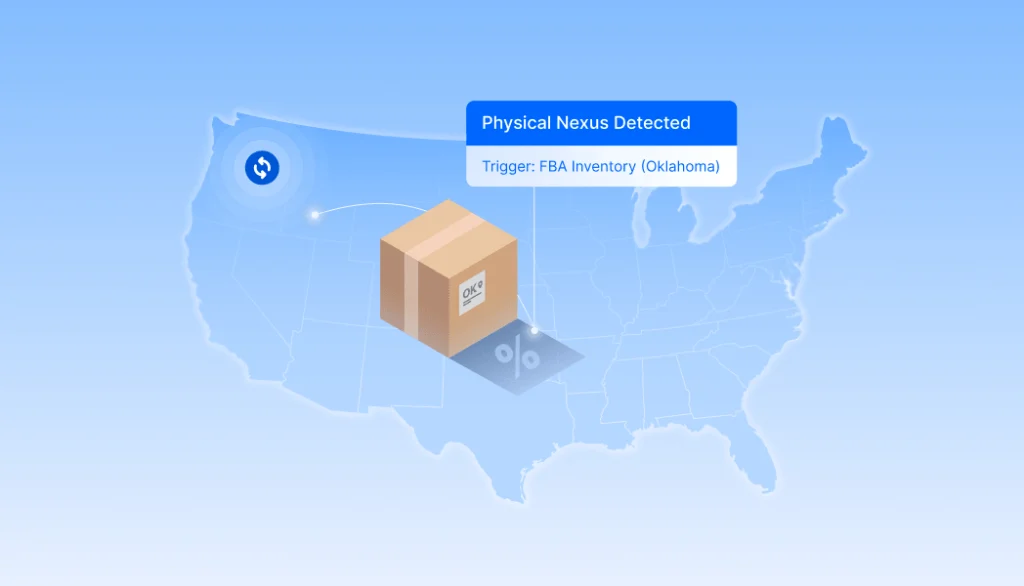
Until 2018 this was pretty much the only test. The Supreme Court said in Quill v. North Dakota (1992) that a state couldn’t make a business collect its tax unless the business had a physical presence there. Most people hear “physical presence” and think of a storefront. States read it wider:
- An office, store, or warehouse
- An employee in the state, even one working from a spare bedroom
- Reps or contractors selling on your behalf there
- Inventory you keep in the state, fulfillment centers included
- Trade shows, installs, or deliveries in your own van, in some states
Fulfillment centers catch a lot of sellers. Use Amazon FBA and your stock can get split across warehouses in several states, sometimes ones you’d never have picked. Hiring is the other trap. Bring on a developer in Colorado and you may have nexus in Colorado. Accounting often finds out last.
Economic nexus
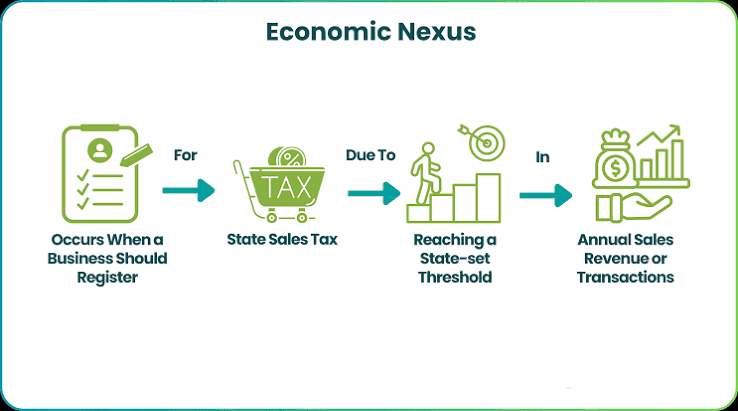
Then South Dakota v. Wayfair came down in 2018 and the physical presence rule was gone. A state could now require a remote seller to collect based on sales alone. South Dakota’s own law, the one in the case, used $100,000 in sales or 200 transactions, and almost every state with a sales tax copied it with tweaks.
The numbers aren’t uniform. California and Texas use $500,000. Plenty of others sit at $100,000. Some states dropped the transaction count, since 200 small orders barely produced any tax, and some kept it. Look up the current number for every state you sell into, because they get revised.
Here’s how it plays out. Say the candle shop ships $40,000 of product a year to Washington, well under the $100,000 line. Then a company orders $70,000 worth of gift sets in November. The year’s total is now $110,000, and the shop has crossed. No warning, no letter, just a number on a spreadsheet nobody was watching.
The fine print is where people get burned:
- Some states count all your sales into the state. Others count only the taxable ones.
- The clock is a calendar year in some places and a rolling twelve months in others.
- Marketplace sales count toward the threshold in some states and not in others.
- When you have to start collecting after crossing the line ranges from right away to the first of the next month.
One big order can put you over in a week. Checking once a year won’t catch that.
Side doors
Physical presence and sales volume cover most situations, but there are others. If you pay commissions to affiliates or bloggers in a state, some states call that click-through nexus. Dropshipping is messy too, since the supplier, the seller, and the buyer may all be in different states and resale certificates enter the picture.
Marketplaces are worth a paragraph. Amazon, Etsy, and Walmart now collect and remit tax on orders placed through them, under marketplace facilitator laws. That takes real weight off you. Your own website is still your job, though, and marketplace sales can still count toward a state’s threshold.
And what you sell changes things. Clothing is taxable in some states and exempt in others, groceries the same, and digital downloads and software subscriptions swing depending on where the buyer lives.
Where sellers slip up
Usually it’s timing. Someone checks state totals in January, sees nothing alarming, and doesn’t look again until next January. They actually crossed a threshold in March. That’s eight months of tax nobody collected.
The overcorrection is just as bad. Some sellers panic, register in twenty states to be safe, and end up filing zero returns every month in places where they owe nothing. It burns hours and helps no one.
One more point: five states have no state sales tax at all, which are Alaska, Delaware, Montana, New Hampshire, and Oregon. The rest, 45 states plus DC, do. Alaska’s a little odd, since local governments there can add their own.
How to handle sales tax nexus, step by step
- Export sales by state for the last two years from your cart or accounting software. Get order counts along with dollar totals.
- Look up each state’s current threshold on the revenue department’s own site. A 2021 blog post won’t do.
- Make a list of everywhere you have staff, contractors, property, or stock. Ask HR about remote workers, and ask your fulfillment provider where your inventory really is.
- Register only in states where you have nexus. The application goes through the state revenue department, and our sales tax registration guide covers the paperwork.
- Check what’s taxable in those states before you set up rates.
- Turn on tax collection at checkout for them, using the buyer’s address to pick the state and local rate.
- File every return the state gives you, even when you collected nothing. A missed zero return can still draw a penalty.
- Recheck every quarter. Any state where you’re past about 70% of the threshold deserves a closer look.
If you already missed it
- Estimate what you owe: sales into the state since you crossed the line, times the combined state and local rate.
- Ask the state about a voluntary disclosure agreement. Many offer one, and it can trim penalties and limit how far back they look. It usually only works if you come forward before they contact you.
- Register and start collecting now, so the number stops growing.
- Leave past customers alone. Most states don’t allow collecting after the fact, and it goes over badly.
- If several states are involved, bring in a CPA or a state and local tax specialist. These bills stack up fast.
Conclusion
Sales tax nexus becomes difficult when you sell goods or services to buyers across many states, use fulfillment centers, or have remote employees. What you should do is to keep track of your sales, your physical location, and the threshold in different states. This way, you will find out whether you have exceeded the threshold in terms of sales tax. After that, you will be able to assess your duties, and register wherever needed. Accounting assist Pro can help you to organize your accounting work.
FAQs
Is sales tax nexus the same as having a physical location?
No. A physical location is one way to get it. Since 2018, sales volume alone can create economic nexus in a state where you have no presence at all.
How much do I have to sell before I need to collect tax?
It depends on the state. Many use $100,000 in annual sales, while California and Texas use $500,000. Some also count transactions. Check the current rule for each state you sell into.
If Amazon collects tax for me, do I still need to worry about nexus?
Yes. Amazon’s collection covers orders placed on Amazon. Sales through your own website still need tax where you have nexus, and inventory in Amazon’s warehouses can create physical nexus in whichever states it’s stored.
Do remote employees create nexus?
Often, yes. A single employee working from home can be enough for a state to say you have a physical presence. Rules for independent contractors vary, so check the state involved.
What happens if I ignore nexus?
You can owe the uncollected tax plus penalties and interest. In many states the statute of limitations never starts running if you never filed a return, so the exposure can reach back years.
Nexus isn’t a one-time setup. Pull your sales by state this week. An hour of work now costs a lot less than an audit later, and it’s the only way you’ll know which states are getting close.
